 Panamahut Shop
 About us
 Contact
 FAQ
FAQ
 Men's hats
 Women's hats
 Montecristihüte
 Accessories
 Panamahut
 Magazine
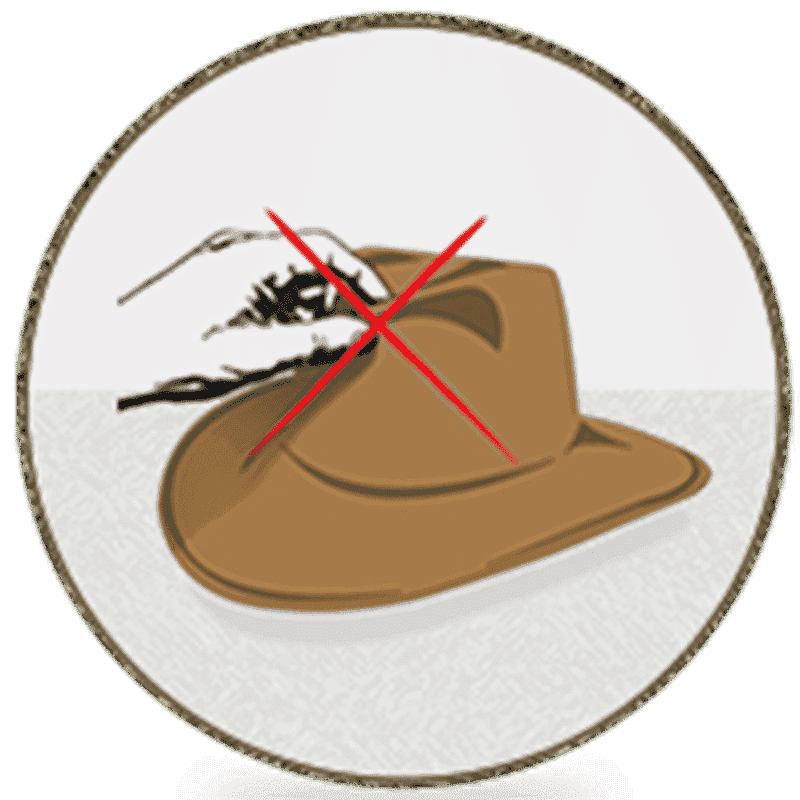
When putting on and taking off your hat, grasp the brim at the front and back. Please try to touch the crown as little as possible.
Hat care
Hat care and storage of your Panama hat
Care of the Panama hat
- Brush your hat regularly to keep it looking shiny and looking great.
- Clean dust or dirt stains with a damp cloth.
- If your hat accidentally gets wet, absorb any excess water with a dry, clean cloth.
- You can gently wipe away dirt stains with a damp cloth, as long as they haven't penetrated the straw. If necessary, you can also use a little soap.
- Try ironing out any wrinkles with an iron. Please use a low temperature setting. Be sure to place a clean, white, damp cloth between the iron and the hat.
- Keep your Panama hat away from artificial heat sources such as heaters, stoves, and lamps. It's used to high humidity and should therefore not dry out.
- When putting on and taking off your hat, grasp the brim at the front and back. Avoid touching the crown as much as possible.
With these tips, good hat care and storage is ensured
Instructions for rolling up your hat
Most of our original Panama hats can be customized due to their quality and flexibility
roll it up, but it should not be bent.
However, if the original shape of your hat is important to you, you should avoid rolling it up
better to do without.
If you do decide to roll up your hat, you do so at your own risk .
Please note the following:
To roll it up, grasp the inside of the hat and press upwards in the middle of the head part.
Then fold the hat in half so that both brims lie flat on top of each other with the inside facing out. Make sure the hat is not bent!
Finally, roll the hat up from the side like an ice cream cone. On one side, the top of the hat
as a point and on the other side slightly wider the rolled brim.
The original Panama hat is made exclusively from the leaves of the toquilla plant, also known as the Panama hat plant. Our fair trade sombreros are woven using an artful handcrafting process and are available in natural white/beige, bleached by boiling.
For a natural/walnut brown color, the stumps are only preserved through a washing process.
A good Panama hat can be easily rolled up and transported in humid tropical climates without damaging the fibers or losing its shape. However, in lower humidity, such as in Europe, the hat should not be rolled or pressed together at the tip, as this will cause the fibers to break more easily. The Panama hat should not be taken off or put on by the crown, but rather only by the brim to avoid fiber breakage due to compression.
However, since very few users pay attention to this, the hats are usually equipped with a reinforcement (crown protecting) on the front inside of the crown.
Other information:
If you plan to roll your hat regularly, it's best to store it in humid rooms. A hat that's too dry should never be rolled.
Nevertheless, the Panama hat is not suitable for heavy rain, as it can lose its ironed shape if it gets very wet. No original Panama hat is completely waterproof.
However, we would like to point out that you do this at your own risk, as we do not recommend rolling it up.
In the country of manufacture, a Panama hat can be safely rolled up and stored in a box due to the warm, humid climate. However, this is not the case in Europe. The dry climate causes straw hats to become brittle and they will not return to their original shape. Furthermore, straw or Panama hats should be handled by the brim, not by the crown as usual.
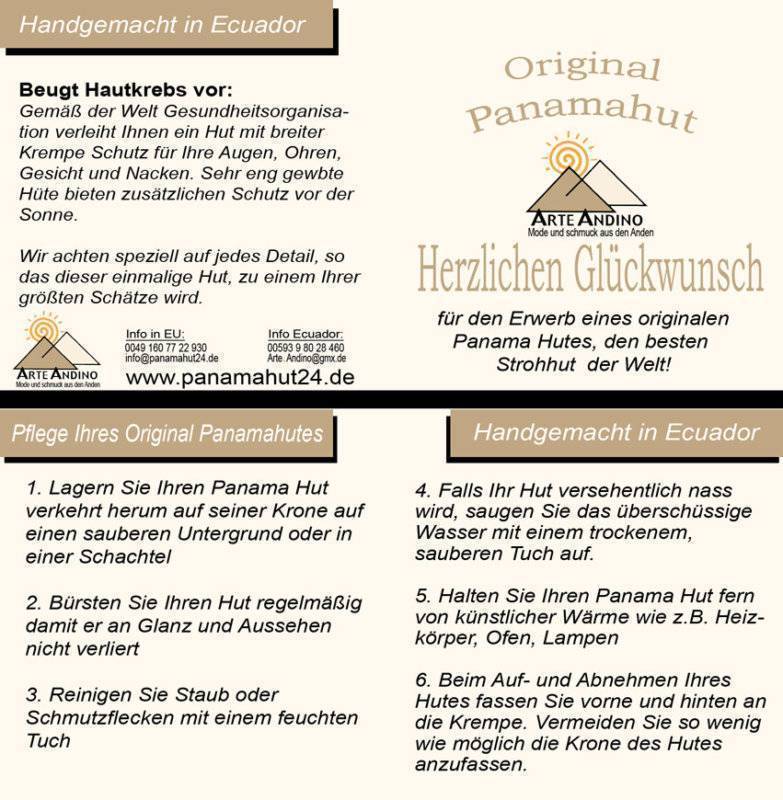
Care instructions for your Panama hat
Each of our original Panama hats comes with care instructions. If needed, you can also send them by email. Please be sure to include your order number or full billing address.
Be careful with copies from other countries!!!
The original Ecuadorian handicrafts from Montecristi feature intricate braided patterns, enlivening the hats with subtle rosettes, spiral-shaped circles, and concentric shapes. The models from the Cuenca highlands are characterized by circular rings.
In addition to the quality of the straw, they are an important identifying feature of a genuine “Panama hat”.
Copies from other countries not called PANAMA HUT were allowed.
The Panama hat is a term used to describe a high-quality headwear handcrafted from the toquilla palm. However, many hats around the world are made or woven from other materials or plant leaves, including more brittle types of straw:
-
- the Iraca palm (grows exclusively in the tropics of Latin America)
- Paper fibers (mainly produced in Asia)
- Straw hat
- Chevalier
- Yeddo
A straw hat is usually woven, but it can also be made from so-called mottlets , several meters long braids of straw (or other material). A special version made from sewn-together straws is also possible (the straw hat, Chevalier hat, Yeddo).
With this technique it is possible to use even more brittle types of cereal straw.
Also well-known brands.
Many well-known brands around the world purchase only Panama straw stumps in Ecuador, specifically in the provinces of Manabí and Azuay, and then mold them outside of the country of origin. Strictly speaking, these products are no longer "ORIGINAL," but are still sold as "Montecristi or Cuenca Panama Hats." Thus, these products are using the protected name of origin (Montecristi and Cuenca) without authorization.